

The Permanent Emergency
How the Pentagon learned to buy the future before it exists


Welcome to Policy & Capital, a substack for operators and investors navigating the federal market. P&C is the official publication of HighGround, the premier AI for Government Demand, built to model the funded intent of the federal system to buy, build, or deploy capabilities through budgets, programs, and policy decisions. Looking at a deal? Run it through Highground
To the Investors, Operators, and Builders Shaping Federal Markets,
The Cold War, as we traced last issue, gave the defense state its basic shape.
Eisenhower’s farewell warning was less a moral alarm than a balance-sheet observation: permanent federal demand converts industrial structure, and Wall Street learned to price the relationship itself as an asset. The architecture was built. The contracts were written. The industrial base was established. What the Pentagon had not yet resolved was what to put inside all of it.
Vietnam answered that question the hard way.
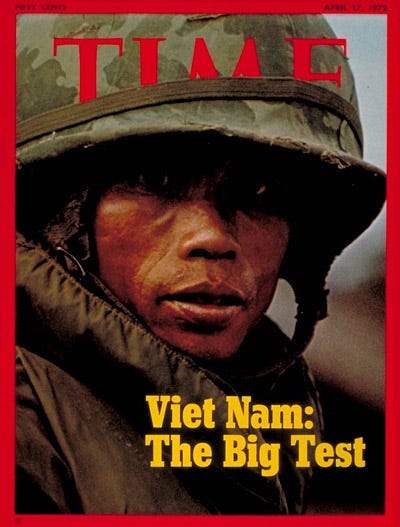
The United States still had factories, steel, aircraft plants, shipyards, and a defense budget large enough to absorb enormous losses. But the war in Southeast Asia was not resolved by mass the way the Second World War had been. It was a conflict of sensors, helicopters, air mobility, electronic warfare, command systems, intelligence, counterinsurgency, and rapid adaptation. The battlefield changed faster than the procurement logic built to supply it.
Think about what that actually meant at the operational level. An American pilot in 1968 could drop more ordnance in a single sortie than an entire squadron could have managed in the Second World War. He had better aircraft, better navigation, better everything. And he could climb back to altitude, look down at the jungle, and have almost no idea whether any of it had mattered. The hardware was extraordinary. The problem refused to cooperate with it.
That mattered because Vietnam exposed a crack in the old architecture.
The defense state could still produce extraordinary quantities of hardware. But hardware alone no longer guarantees strategic clarity. Bombs did not solve uncertainty. Aircraft did not solve politics. Manpower did not solve the problem of an enemy that could absorb losses and keep fighting. The Pentagon was forced to confront a new reality: the future of war would be decided less by brute capacity than by the ability to integrate systems that could evolve faster than the threat.
The postwar industrial order had been built to make things at scale. The emerging defense order had to make things that stayed relevant.
From mass to systems
The older logic of defense spending was straightforward. In the Second World War, the state bought output: ships, bombers, tanks, uniforms, fuel, and ammunition. The object was to convert industrial throughput into battlefield dominance. Cold War planning kept much of that structure alive but added another layer. The United States no longer expected a single total war. It was expected to be an enduring competition, one in which the contest itself could last for decades.
That changed the product.
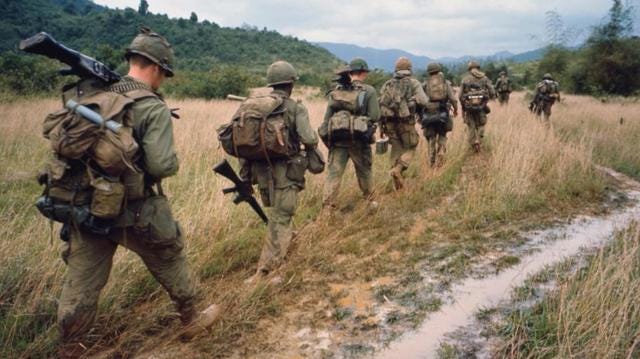
By the 1960s and 1970s, the Pentagon was no longer simply purchasing platforms. It was purchasing the architecture around platforms. Radar had to talk to aircraft. Aircraft had to talk to command centers. Command centers had to talk to satellites. Satellites had to talk to intelligence systems. Weapons had to be guided, updated, maintained, and connected to the rest of the force. The real military advantage was no longer in the machine. It was in the network of dependencies surrounding the machine.
The procurement question became: how do you buy an ecosystem?
That is a harder question, and a more profitable one for the firms that can answer it. Systems are harder to replicate than products. They require integration, software, training, data, testing, maintenance, and long-term support. Once the Pentagon begins buying systems, it is no longer making one-time purchases. It is entering a relationship. And relationships, unlike transactions, compound.
Vietnam as a transition
Vietnam did not create this shift by itself. It revealed it with unusual force.
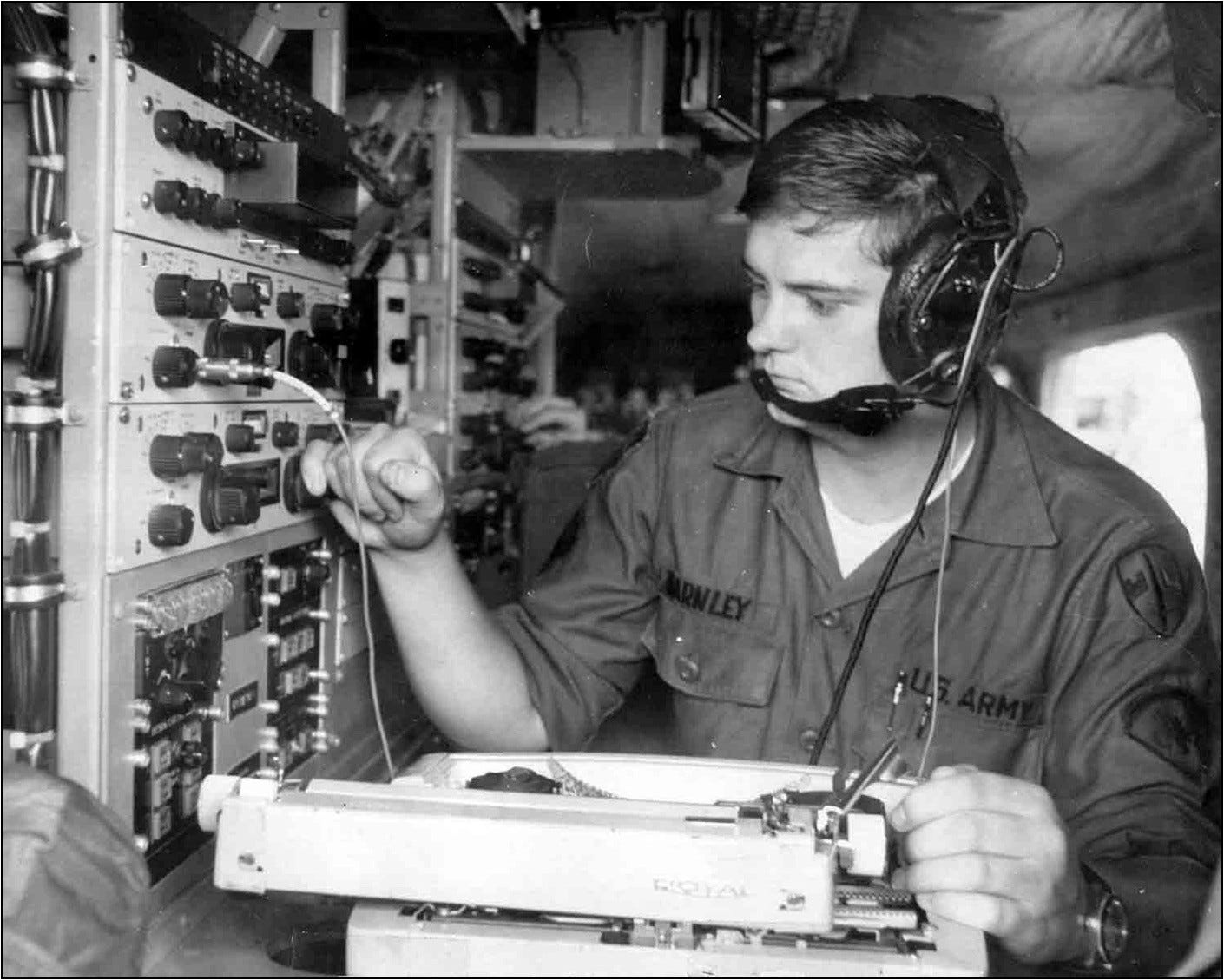
The war was fought with increasingly sophisticated aviation and electronics, yet the strategic results remained elusive. The United States could destroy targets, move troops, and dominate the air. It could not convert that power into a political end state that matched the scale of the spending.
That was a humiliating lesson for the defense establishment. It was also an instructive one.
If traditional industrial supremacy could not guarantee victory, then the next version of military advantage would have to come from something more dynamic. Not simply more hardware. Better coordination, better intelligence, faster adaptation, tighter integration between public institutions and private contractors. The Pentagon needed firms that could do more than manufacture. It needed firms that could help manage complexity.
That is where the defense industry began to change shape. Contractors were no longer judged only by how many units they produced. They were judged by how deeply they could embed themselves in the architecture of national security. The more deeply a firm understood the system, the more indispensable it became. The more indispensable it became, the less it looked like a vendor and the more it looked like infrastructure.
That transition did not happen overnight. Vietnam made it visible.
By the late 1970s and 1980s, defense spending had become tied to doctrine, systems integration, and the promise of technological superiority. The Carter and Reagan years accelerated this logic in different ways. The direction was the same. The Pentagon was shifting from buying mass to buying advantage, and advantage increasingly meant interoperability, flexibility, and the ability to update the force without rebuilding it from scratch.
That is a very different business model.
The systems era
The Gulf War made the systems era impossible to ignore.
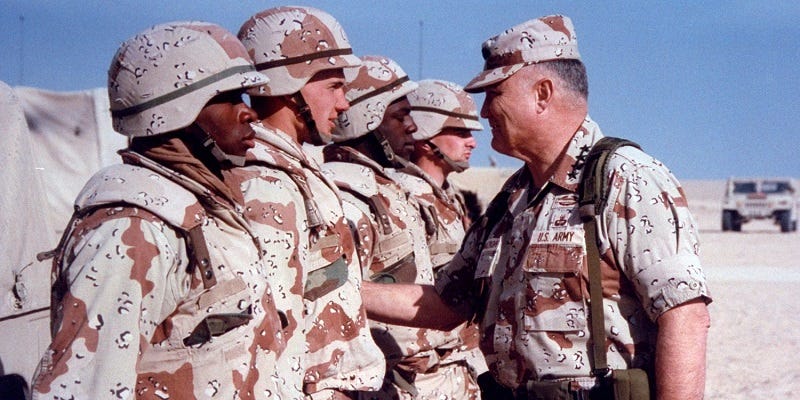
Operation Desert Storm was a demonstration, not just of American military power, but of how thoroughly the Pentagon had learned to fuse hardware, software, communications, reconnaissance, and logistics into a single operational machine. Precision-guided munitions, stealth aircraft, satellite navigation, command-and-control integration, and real-time battlefield awareness created the impression that war had entered a new phase. The war appeared fast, clean, and technologically decisive.
It was also a sales pitch.
Millions of people watched it on television like a product launch. Grainy green crosshairs. Buildings disappearing in a single frame. Military briefers pointing at before-and-after satellite imagery with the calm confidence of a quarterly earnings call. The message was unmistakable: this is what American technology had become capable of. The implication, for every contractor watching, was equally clear: the government would pay whatever it took to maintain that image.
The lesson drawn by policymakers and contractors alike was that the future belonged to integrated systems. A platform by itself was not enough. A system that made the platform part of a broader operational architecture was far more valuable. What the Pentagon wanted to buy was no longer just an airplane, a missile, or a radar array. It wanted the connective tissue that made those objects useful together.
That had enormous implications for procurement. A systems-based defense economy naturally rewards firms that can stay inside the architecture for decades. Build the communications layer, the upgrade path, the training suite, the data standards, the maintenance envelope, and you are not selling equipment. You are creating lock-in.
The commercial analogy is software. The military version is more durable, because the buyer cannot easily walk away. A broken app can be deleted. A broken command network cannot.
The Gulf War, therefore, marked a turning point in both the public imagination and the defense business. It reinforced the belief that the United States could buy its way into future dominance by funding the right combination of sensors, precision, and integration. It also taught contractors that the highest-margin position was not at the edge of the system. It was inside the system, where replacement costs, compatibility concerns, and institutional knowledge all favored incumbency.
That is how the market learned to price the future.
Perpetual modernization
After 9/11, the logic hardened into something more permanent.
The wars in Afghanistan and Iraq were not the kind of mobilization that defined the 1940s. They were long, diffuse, and adaptive. The enemy was not a standing army. It was decentralized, mobile, technologically improvised, and difficult to locate. That forced the Pentagon into a posture of constant revision. New threats required new tools. New tools required new data. New data required new networks. New networks required new contractors.
The result was not simply higher spending. It was perpetual modernization.
Consider what that looked like on the ground. A soldier in Kandahar in 2007 might be carrying gear sourced from a dozen different contractors, connected to a command network managed by a dozen more, supported by logistics chains that stretched back to facilities his own chain of command had never visited. He did not need to understand the architecture. He just needed it to work. Somewhere back in northern Virginia, in an office park off the interstate, a program manager at a mid-tier defense firm was making sure it did. That was the new division of labor. The warrior at the edge of the system. The integrator at its core.
That phrase matters because it captures the core of the modern defense economy. The Pentagon is no longer buying systems to finish a war. It is buying systems to keep pace with a changing threat environment: upgrades, patches, revisions, retrofits, software refreshes, cybersecurity protections, new sensors, new platforms, new data standards, and new layers of integration. The program does not end. It matures into its own maintenance cycle.
In that world, obsolescence becomes a business opportunity. A system that lasts too long creates risk. A platform that performs too well for too long invites replacement by the next threat. A contractor who can anticipate this cycle can turn it into recurring revenue. The state pays to keep itself current, and current is always a moving target.
This is why modern defense procurement looks less like a set of discrete purchases and more like a subscription model with national security implications. The government is not buying the future in one transaction. It is financing the continuous effort to stay ahead of it.
That shift also changed the role of the contractor. In the Cold War industrial model, the contractor was often a manufacturer. In the post-9/11 systems model, the contractor became an integrator, data manager, software updater, logistics partner, and strategic consultant. The firm that could move between those roles became more valuable than the firm that simply built the thing.
The architecture of dependence
Once systems become central, the real power shifts to whoever controls the interfaces.
That is the part of the story that most analyses miss. The Pentagon does not merely depend on the contractor for hardware. It depends on the contractor for compatibility, interoperability, upgrade pathways, and continuity of knowledge. If the system is deeply integrated, changing suppliers becomes costly, slow, and risky. The state is still sovereign, but it is operating inside an architecture that increasingly reflects private design choices.
That creates a durable form of leverage.
A prime contractor that owns the architecture around a platform can remain embedded long after the original purchase. It supplies the software refresh, the maintenance contract, the training pipeline, the analytics layer, the spare parts, the cybersecurity wrapper, and the next generation of upgrades. Each piece extends the relationship. Each relationship extends the holding period. Each holding period deepens the market’s confidence that the revenue stream will continue.
This is where defense spending became more than a budget line. It became a structure of institutional dependence.
The logic is self-reinforcing. Once a system is embedded, it is too costly to remove quickly. Once it is too costly to remove quickly, the incumbent gains protection. Once the incumbent gains protection, capital begins to treat the relationship as durable. That durability encourages larger bets, longer planning horizons, and more investment in the very architecture that created the lock-in in the first place.
That is not just procurement. It is compounding.
The permanent emergency
The post-9/11 state made that compounding logic feel normal.
The language of emergency became permanent. Homeland security, counterterrorism, intelligence fusion, drone surveillance, persistent monitoring, cyber defense, special operations, distributed command structures, and global strike all implied the same basic premise: danger would not arrive in one fixed form, and the state had to remain ready for a moving target. The problem was never solved. It was managed.
At some point, the management became the mission. The emergency did not feel like an emergency anymore. It felt like the weather. Permanent, variable, demanding constant preparation but never quite arriving in the catastrophic form that would finally resolve it. That normalization had a cost, and the cost was structural: a defense economy calibrated not to fight a war and stop, but to remain perpetually ready for a war that might arrive in any shape.
That management model is expensive. It is also politically resilient. No administration wants to be accused of underinvesting in preparedness. No official wants to preside over a system that failed because the next modernization cycle came too late. The result is a broad consensus around continuity, even when continuity is itself the source of the cost structure.
The logic is visible in the current language of defense budgeting. AI, autonomy, cyber, space, hypersonics, drones, and industrial base resilience are all framed as necessary responses to a changing threat environment. They are also the latest labels attached to the same deeper imperative: buy ahead of the threat, integrate before the threat scales, modernize before the threat arrives.
That is why the Pentagon increasingly funds ecosystems rather than standalone products. Cloud architectures, data pipelines, resilient supply chains, and software-defined platforms that can be updated without starting over. It wants the future preloaded into the present. It wants to reduce the gap between strategic intent and operational reality.
In practice, that means the most valuable defense firms are not necessarily the ones with the best hardware. They are the ones most capable of remaining relevant across the next cycle of threat reassessment.
Why this matters now
The modern defense economy is not organized around a single war. It is organized around the expectation that war will never quite stop being possible.
That expectation shapes industrial policy, capital allocation, and political behavior. It encourages federal support for domestic capacity, but it also rewards firms that can absorb public priorities into long-duration commercial structures. The state wants resilience. The market wants visibility. The contractor wants renewal. Those interests overlap enough to keep the machine moving, but not enough to simplify it.
That is the core lesson of the permanent emergency. The defense budget is no longer just a measure of current danger. It is an instrument for buying optionality against future danger. The Pentagon is funding the ability to move faster than uncertainty.
And because uncertainty does not end, the contract does not end either.
The Revolutionary War created the credit market. World War II created the industrial base. The Cold War taught Wall Street how to hold both for the long run. Vietnam taught the Pentagon that mass was not enough. The Gulf War taught it to buy systems. Post-9/11 taught it to buy readiness as a permanent condition.
The contract is still open. The future has simply become the next line item.
Sources & Further Reading
Dwight D. Eisenhower, Farewell Address, January 17, 1961.
U.S. Department of Defense, historical materials on Vietnam War procurement and force modernization.
Office of the Secretary of Defense, reporting on the Gulf War and the evolution of precision warfare.
Congressional Research Service, reports on post-9/11 defense procurement and contracting.
RAND Corporation, studies on systems integration, command-and-control, and military modernization.
Paul N. Edwards, The Closed World: Computers and the Politics of Discourse in Cold War America.
Andrew Bacevich, The New American Militarism.
Fred Kaplan, The Wizards of Armageddon.
Jacques S. Gansler, The Defense Industrial Base and the Future of American Military Power.
Next issue, No. 5: The Capital Stack. The permanent emergency created the demand signal. What followed was a question of who could finance it, and on whose terms. We trace how private capital learned to sit inside the defense architecture: from early-stage venture bets on dual-use technology to the sovereign-adjacent revenue streams that now underpin the largest primes. The money found the machine. The question now is whether the machine has learned to find the money first.
Policy & Capital turns federal policy signals into capital intelligence for investors and operators in the defense and national security ecosystem. We track the gap between what Washington is signaling and where money has actually moved, because that gap is where the opportunity lives. Published independently. Written for professionals who want to read the signal before it becomes consensus.
— Highground
AI For Government Demand